Confused About Mammogram Recommendations? Here’s What You Need to Know
You decide to do the responsible thing and look up when you should get a mammogram. Ten minutes later, you’re staring at conflicting recommendations: age 40, age 50, every year, every other year. Instead of feeling informed, you feel more confused than when you started.
If you’ve come away from researching breast cancer screening feeling frustrated, you’re not imagining things. The differences in recommendations are real—and there’s a reason for them.
The good news? These organizations share the same goal: saving lives through early detection. The differences come down to how they weigh the benefits and potential drawbacks of screening, and the questions they’re trying to answer.
Understanding why these recommendations differ—and which approach makes the most sense for you—doesn’t require a medical degree. It just takes a little context about how screening guidelines are developed and how personal risk factors influence screening decisions.
Key Takeaways
- Most major organizations now recommend starting mammograms at age 40 for women at average risk.
- Differences in guidelines primarily involve how often to screen and when screening should stop.
- Your personal and family health history may mean you need earlier or additional screening.
- The best screening plan is one tailored to your individual risk.
Why Screening Guidelines Differ
The two organizations most women encounter when researching mammogram timing are the U.S. Preventive Services Task Force (USPSTF) and the American College of Radiology (ACR), working jointly with the Society of Breast Imaging (SBI).
Both now agree that screening should begin at age 40 for women at average risk—a meaningful shift since the USPSTF previously recommended starting at age 50. Where they still differ is screening frequency and duration.
USPSTF vs. ACR/SBI at a Glance
| Screening Mammogram | USPSTF | ACR/SBI |
| Start Age | 40 | 40 |
| Frequency | Every 2 years | Every year |
| End Age | Through age 74 | No upper age limit if in good health |
| Primary Focus | Population-level benefits and harms | Earliest possible detection for individuals |
These differences exist because the organizations are evaluating different questions, not because one is right and the other is wrong.
The USPSTF evaluates screening recommendations at the population level, balancing lives saved against potential downsides such as false-positive results, additional imaging, biopsies that ultimately prove benign, and the anxiety that can accompany follow-up testing.
The ACR and SBI approach the issue from the perspective of the individual patient. Their recommendations prioritize the opportunity to detect cancer as early as possible, even if that results in more callbacks and additional imaging.
That focus on early detection is rooted in outcomes. According to the American Cancer Society, when breast cancer is detected at its earliest, localized stage, the five-year relative survival rate exceeds 99 percent.
Why Personal Risk Matters
Consider two women who are both 42 years old.
One has no family history of breast cancer and no additional risk factors. The other has dense breast tissue and a mother who was diagnosed with breast cancer before age 50.
Even though they’re the same age, their screening plans may look very different.
That’s because screening guidelines are written for women at average risk—but not every woman falls into that category.
What CRL Women’s Imaging Recommends
At CRL Women’s Imaging, we follow the ACR and SBI recommendations of annual mammograms beginning at age 40 for women at average risk and continuing as long as a woman remains in good health.
The reason is simple: annual screening provides the greatest opportunity to detect breast cancer at its earliest—and often most treatable—stage.
“We know that no single guideline fits every woman, which is why we look at the complete picture—family history, breast density, personal risk factors—to help guide screening decisions that are tailored to the individual,”
–Dr. Jillian Karow, Medical Director, CRL Women’s Imaging
Understanding Your Personal Risk
The ACR recommends that all women undergo a formal breast cancer risk assessment by age 25. This recommendation is especially important for Black women and women of Ashkenazi Jewish descent, who face higher risks associated with certain genetic factors and earlier-onset disease.
You may benefit from earlier or additional screening if any of the following apply to you:
- A first-degree relative (mother, sister, or daughter) diagnosed with breast cancer, particularly before menopause
- A personal history of a breast biopsy showing atypical hyperplasia or lobular carcinoma in situ (LCIS)
- Dense breast tissue
- Known genetic mutations such as BRCA1, BRCA2, PALB2, ATM, or CHEK2
- Chest radiation therapy before age 30, such as treatment for Hodgkin lymphoma
- A personal history of breast cancer
It’s also important to remember that family history matters on both sides of your family. A father’s history can be just as significant as a mother’s.
Whenever possible, gather this information and discuss it with your primary care provider before your appointment rather than trying to recall details during the visit.
So, What Should You Do With This Information?
Start by talking with your healthcare provider about your personal risk factors.
A formal risk assessment can help determine whether earlier screening, more frequent screening, or supplemental imaging would be beneficial based on your individual circumstances.
The goal isn’t simply to follow a guideline—it’s to follow the guideline that’s right for you.
What You Can Control (and What You Can’t)
Some factors are within your control:
- Staying current with recommended mammograms
- Learning your family health history
- Sharing that information with your healthcare provider
- Paying attention to changes in your breasts between appointments
Other factors—such as genetics, age, breast density, and chance—are not.
Those factors are not anyone’s fault, and they shouldn’t create guilt or unnecessary worry. Focus instead on the steps you can take and work with your provider to create a screening plan that matches your risk.
Questions Worth Bringing to Your Primary Care Visit
The best way to make screening decisions with confidence is to arrive prepared for a conversation with your healthcare provider.
Consider asking:
- Based on my personal and family history, which screening approach makes the most sense for me?
- Do I need a formal risk assessment, and what is my calculated lifetime risk?
- Should I begin screening before age 40 or consider supplemental imaging?
- What does my breast density mean for my screening plan?
- Would genetic counseling be appropriate given my family history?
A Note on Insurance Coverage
Most insurance plans cover screening mammograms with no copay or deductible, although benefits vary by plan. Diagnostic mammograms and additional imaging are often subject to standard plan benefits and cost-sharing.
For individuals without insurance coverage, the Minnesota Sage Program offers free or low-cost breast cancer screening for eligible patients. CRL Women’s Imaging in Edina accepts Sage patients.
Because coverage varies, it’s always a good idea to verify your benefits directly with your insurance provider before your appointment.
The Bottom Line
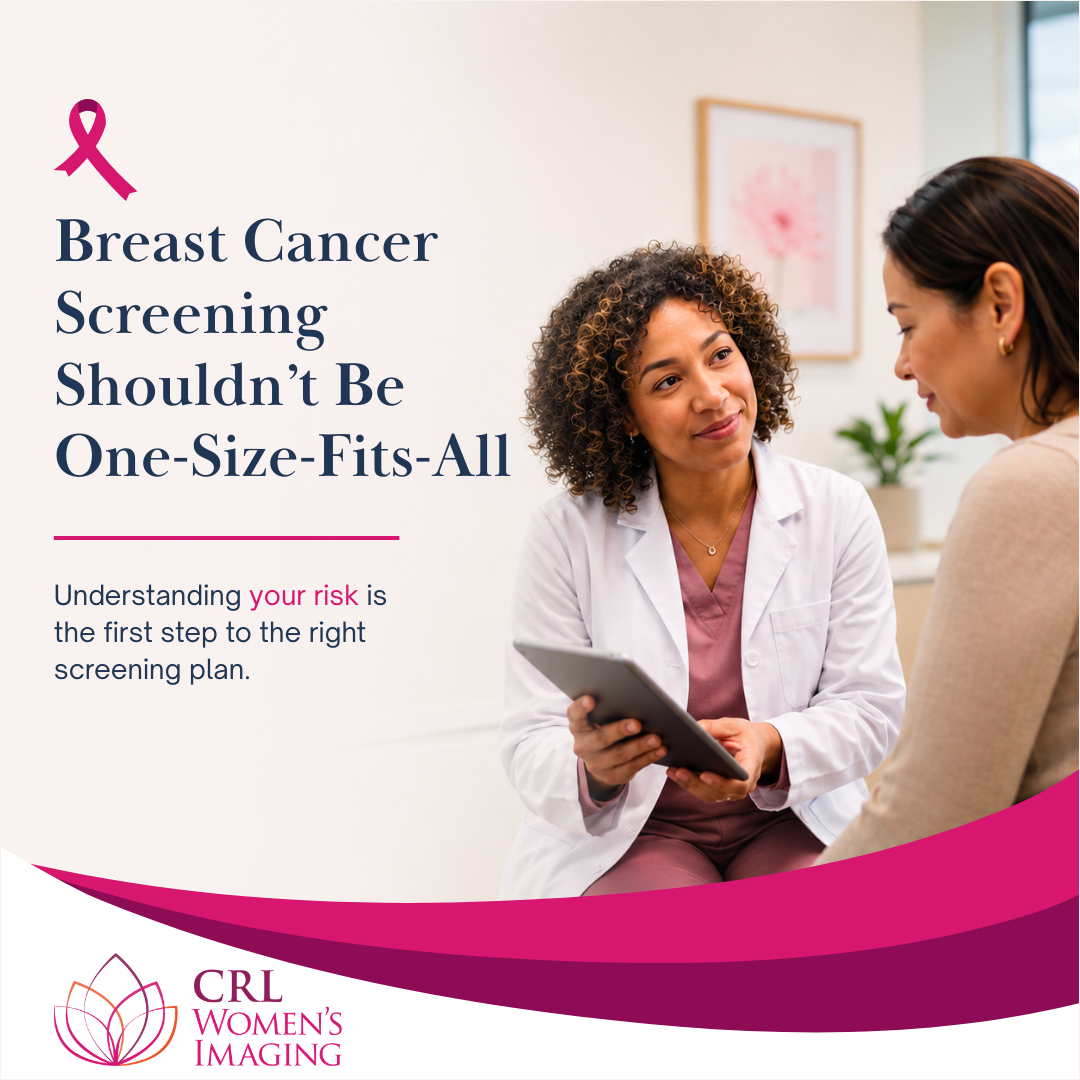
Screening guidelines provide a framework—not a one-size-fits-all answer.
Whether you’re approaching age 40, already receiving annual mammograms, or wondering if additional screening might be appropriate, the most important step is understanding your personal risk.
An informed conversation with your healthcare provider can help ensure you’re following the screening plan that’s right for you.
Because when it comes to breast cancer, early detection isn’t about worrying more—it’s about giving yourself the best chance to stay healthy.
Ready to schedule your appointment or have questions?
About CRL Women’s Imaging
CRL Women’s Imaging is a leader in outpatient imaging and designated a Breast Center of Excellence by the American College of Radiology (ACR). Our team of board-certified breast imagers and certified technologists in mammography and ultrasound are committed to providing high-quality, compassionate care that women can trust.